Emergency Commercial Plumber in Prospect Heights, IL
Water coming through the ceiling, a pipe that has split, or no water at all? You need an emergency commercial plumber in Prospect Heights, and you need one now. Call (847) 534-9849. We’re open 24/7 and we work from Prospect Heights, IL.
If you can reach the main water valve, shut it off first. Then call us. You get the price in writing before any work starts.
When Is a Plumbing Problem a Commercial Emergency?
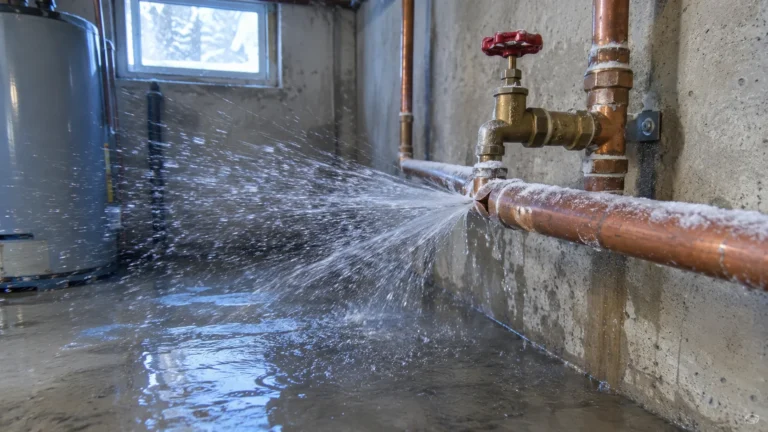
It’s an emergency when it stops you from doing business, or when it’s damaging your building right now. A burst pipe, a frozen pipe and a loss of water all count. A slow drip under a sink can wait for a normal visit.
Here are the signs you should not wait:
- Water is spraying, running or pooling and you can’t stop it
- A pipe has a bulge or a crack line
- Water is coming through a ceiling or running down a wall
- A pipe is frozen and the tap has stopped running
- Your whole building has lost water
- Wet floors are putting staff or customers at risk
Two questions sum it up. Is water spreading? Can your staff and customers still use the space safely? If water is spreading, or the answer to the second question is no, call now.
What can wait till morning: a slow drip under a sink, a running toilet, or a drain that is slow but still draining. These are annoying, not emergencies, so book a normal visit for them. But if a slow drain stops draining completely, or a drip turns into a steady stream, it has become an emergency. Call then.
A drain that keeps slowing down again usually needs hydro jetting, which clears the line instead of just poking through the clog.
Who gets hit hardest depends on the business. A restaurant with a split pipe over the kitchen can’t prep or serve, and a restroom out of service sends customers elsewhere. A restaurant with a slow drain can even fail a health inspection. An office with no water has to send people home. A shop with water on the floor risks its stock and its customers’ safety. A warehouse or a managed property has the same problem at a bigger scale: more floor, more stock, more people affected.
What to Do First at Your Business
Shut off the main water valve, then call (847) 534-9849. That stops more water from reaching the problem. A burst pipe keeps doing damage for as long as water keeps running through it.
The main valve is usually where the water line enters the building, often near the water meter. If you cannot find it, call anyway. Do not wait to look for it while water is running.
Once the valve is off, and only if it’s safe:
- Move stock, paper files, electronics and equipment off wet floors.
- Keep staff and customers away from the wet area.
- Take photos of the damage for your records.
- If you rent the space, tell your landlord or property manager.
Don’t try to repair a split pipe yourself. A burst pipe is a job for a plumber, and a repair that fails under pressure makes the water damage worse.
One more rule for frozen pipes. If you see a bulge or a crack line, that section has been stressed. Don’t try to thaw it yourself. The damage from a frozen pipe often happens at the thaw, not at the freeze, so a pipe that looks fine while frozen can start leaking once it warms up.
Find Your Main Water Valve Before You Need It
The first step in every emergency is the same: shut off the main water valve. You can’t do that if nobody knows where it is.
Walk the building this week and find it. Look where the water line enters the building, often in a utility room, a back room or a basement. Make sure every person who opens or closes the business knows the spot. Put a tag on the valve so it’s easy to spot in a hurry.
Check that the valve turns. A valve nobody has touched in a long time can be stiff, and you don’t want to learn that during a flood.
If you rent in a shared building, ask your property manager two questions now. Where is the main valve, and who has the key or access? In some buildings the valve for your unit is controlled by the landlord. Knowing that before a burst pipe saves you a lot of stress at 2 a.m.
Emergency Plumbing Problems We Handle
These are the calls where a business can’t wait until Monday.
Burst pipes
A burst pipe is a split in the pipe wall, and water escapes from the split. It can be a thin crack or a wide tear. The water spreads fast, soaks floors and walls, and goes wherever the building lets it go.
Frozen pipes
A frozen pipe has ice inside it. Freezing and bursting are different events. Many frozen pipes thaw without damage if they’re caught early and thawed gently. If you have a frozen pipe that hasn’t split, call early. Read about our frozen pipe repair service to see how we handle it.
Leaks from split pipes
A split pipe doesn’t always spray. Sometimes it leaks slowly inside a wall or above a ceiling, and you only see a damp patch or a stain. If a stain is growing or a wall feels wet, treat it as an emergency and shut off the main valve.
If you have a different plumbing emergency, call anyway and we’ll tell you whether we can help.
For everything commercial, start with our commercial plumbing service. This post is the emergency playbook for it.
What Happens on a Burst Pipe Call
Here’s what a typical burst pipe call looks like at a business.
First, the water gets shut off at the main valve. If you’ve already done it, that’s a head start. If you haven’t, we’ll tell you how on the phone.
Next, we find the split. That’s easy when the pipe is exposed and harder when it’s inside a wall or under a slab, because the wall or floor may have to be opened to reach it.
Then the pipe gets repaired. The burst section is cut out and replaced, and the system is pressure-tested after the repair. Nearby lines in the same cold zone get checked before we leave, and you get insulation and heat-cable recommendations for the exposed run, so the same pipe does not freeze again.
Once the pipe is fixed, the wet area has to be dried and repaired. That last part is the one most people forget, and it’s often a big part of the final cost.
Before any of this starts, you get the price in writing. You read it, you ask questions, and you approve it.
After the Emergency: Drying and Repair
Fixing the pipe stops the water. It does not undo the water that already escaped. Wet drywall, wet flooring and wet stock do not dry on their own, and the longer they stay wet, the bigger the repair becomes.
That is why drying is part of the job, not an extra. The wet area gets dried, and then it gets repaired. A small damp patch needs far less than a room where water ran for hours. When you see the written price, this is the part that explains why the number is what it is: the pipe, the drying, and the repair after it.
If water reached stock, paper files or electronics, move them out of the wet area as soon as it is safe, and take photos first. Your records help you, and they help anyone else who needs to see what happened.
What to Tell Us When You Call
A few details help your emergency commercial plumber in Prospect Heights understand the problem before we get there. Have these ready if you can:
- The address of the building and which unit or floor
- Where the water is coming from, if you can see it
- Whether you’ve shut off the main valve
- Whether the pipe is in a wall, a ceiling, a storeroom or out in the open
- Whether you see a bulge, a crack line or a split
- Who will meet us at the building, and whether any rooms are locked
You don’t need all of it. If you only know that water is running, that’s enough to call. We’ll ask the rest.
Emergency Commercial Plumbing for Different Kinds of Businesses
Every business loses something different when a pipe lets go. These are typical cases, not specific jobs.
Restaurants and food service
A split pipe above a kitchen or prep area can stop service for the day. Water near food, equipment and walk-in storage is not something you work around. Shut off the water, move stock out of the wet area, and call.
Restaurants also need backflow testing, so dirty water cannot flow back into the clean supply.
Offices
An office with no water has to send people home. A leak above a ceiling can soak carpet, desks and computers before anyone sees it. Move electronics and paper files first, if it’s safe, and tell your property manager.
Retail shops
Water on a shop floor puts stock at risk and makes the floor unsafe for customers. A slippery floor is a reason to close off the area right away, even before the plumber gets there.
Warehouses and storage units
Large spaces can hide a leak for a long time. A split pipe in a back corner may run for hours before someone walks by. If you find water in a storage area, shut off the main valve and move anything stored low to the floor.
Shared and multi-tenant buildings
In a shared building, water doesn’t stay in one unit. It can run down to the unit below or across to the unit next door. Tell your property manager as soon as you call us, so neighbors can protect their space too.
What Downtime Means for a Business
A plumbing emergency at a business is different from one at home. At home, you can wait it out. At a business, every hour with water running or no water at all can mean lost sales, sent-home staff and cancelled appointments.
That’s why we answer the phone 24/7, and why you should call as soon as you see the problem. The sooner the water is shut off and the pipe is fixed, the sooner the area can be dried and repaired, and the sooner you can get back to work.
Two seasons shut a business down. Winter freeze splits pipes in storerooms, back rooms and along exterior walls. Spring storms are the other one: May and June bring the heaviest rain, and ground-floor businesses flood first. Both are emergencies the moment water is inside.
Every hour a business is closed is an hour of lost sales, lost bookings, or staff standing around with nothing to do. That is why the first call matters more than the perfect call. Shut off the valve if you can, call, and let us take it from there.
How Pricing Works
The price depends on four things:
- What’s wrong with the pipe
- Where the pipe is, whether it’s easy to reach, inside a wall or under a slab
- How much water has already escaped
- How much drying and repair the area needs
A pipe you can reach easily costs less than one inside a wall or under a slab. A small amount of water costs less to deal with than a room that has been soaking for hours.
We don’t pretend to know your price before we know your problem. What we do promise is this: you see the price in writing before work starts. You read it, you ask questions, and you approve it. Nothing begins until you do.
Frozen Pipes in Commercial Buildings
Pipes freeze where the building is coldest. In a commercial building that usually means storerooms, back rooms, spaces along exterior walls, areas above ceilings and anywhere near a loading door that gets opened all day.
Closed buildings are at higher risk. When a business closes for a weekend or a holiday, the heat often gets turned down and nobody is there to notice a problem. A pipe can freeze overnight, split, and then leak when the building warms up again.
Remember the key point: freezing and bursting are different events. If you catch a frozen pipe early, it can often be thawed gently without damage. With professional equipment, most single frozen sections thaw in 30 minutes to a few hours. Gentle DIY heat takes one to six hours, and if an exposed pipe hasn’t moved after 45 minutes, the freeze is deeper than you can see. If it has a bulge or a crack line, it needs a plumber, not a hair dryer or a heat gun.
Winter Checklist for Business Owners
A little work before the cold arrives can save you a very bad morning. Here’s a short checklist:
- Insulate exposed pipes in storerooms, back rooms and along exterior walls
- Seal drafts around pipes, doors and walls
- Keep indoor heat at 55°F or above even when the building is closed
- On extreme cold nights, run a pencil-thin trickle of water at a tap on an exterior wall
- Make sure staff know where the main water valve is
- Post our number where everyone can find it: (847) 534-9849
Before the May rains, check that ground-floor drains are clear, so storm water has somewhere to go instead of onto your floor.
Make sure the sump pump works before the May rains.
Our frozen pipe prevention guide has the full steps.
Serving Businesses in Prospect Heights
We’re based in Prospect Heights. Whether your business is on Milwaukee Avenue, Elmhurst Road or Palatine Road, you call the same number: (847) 534-9849.
The same goes for businesses along Rand Road (US-12), around Chicago Executive Airport, near the Prospect Heights Metra station, and by Old Orchard Country Club. We serve restaurants, shops, offices, warehouses and property managers across Prospect Heights and the Milwaukee Avenue corridor.
Restaurants, offices, shops and other commercial buildings all need an emergency commercial plumber in Prospect Heights at some point. If it’s a burst or frozen pipe at your business, we want the call, any hour of the day or night.
Emergency Commercial Plumber in Prospect Heights: FAQ
Are you open 24/7?
Yes. You can call (847) 534-9849 any hour of the day or night.
What should I do first when a pipe bursts at my business?
Shut off the main valve, then call. Move stock and equipment off wet floors if it’s safe, and keep people away from the wet area.
When do I get the price?
You get it in writing before work starts. You approve it first, and then the work begins.
Does a frozen pipe always burst?
No. Freezing and bursting are different events, and many frozen pipes thaw without damage if caught early and thawed gently. A bulge or crack line is the danger sign, and that section should not be a DIY thaw.
Can my business stay open during a plumbing emergency?
It depends on where the water is and whether the space is safe. If water is spreading, floors are wet, or you’ve lost water, close off the affected area first and tell us when you call. We’ll talk through your situation on the phone.
How do I prevent frozen pipes at my business?
Insulate exposed pipes, seal drafts, and keep indoor heat at 55°F or above even when the building is closed. On extreme nights, run a pencil-thin trickle of water. Our prevention guide has the full steps.
A plumbing emergency won’t wait for business hours, and neither do we. Shut off the main valve if you can, then call.
Call (847) 534-9849. Open 24/7.